


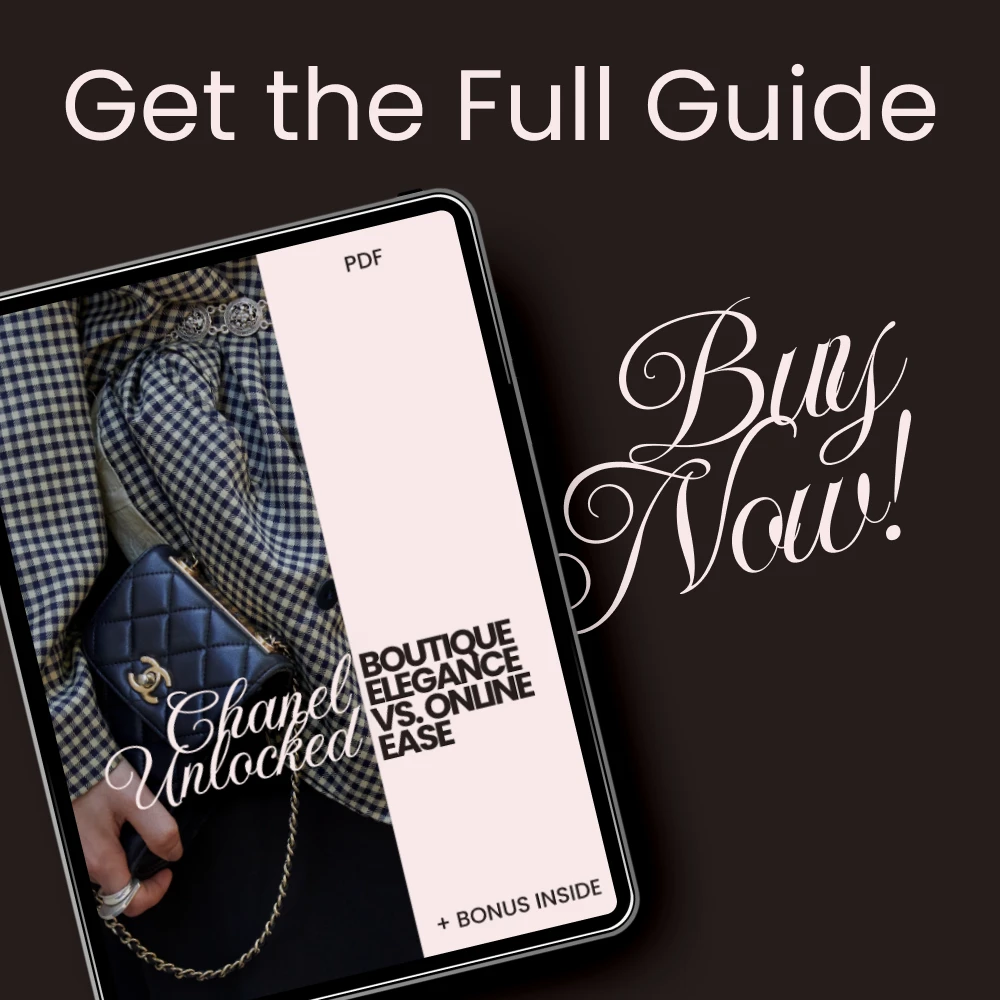

Discover the Best of Both Worlds: Chanel Shopping, Unlocked
Step into the world of Chanel like never before with our digital guide, Chanel Unlocked: Boutique Elegance vs. Online Ease. This exclusive resource will take you on a journey through the luxury brand’s iconic shopping experiences—comparing the timeless elegance of boutique visits with the ease and convenience of online shopping. Whether you’re a Chanel aficionado or a first-time shopper, this guide helps you navigate the delicate balance between exclusivity and accessibility, ensuring you make the best choice for your next purchase.
Key Features:
- In-depth comparisons: Learn how the Chanel experience differs between in-store visits and online shopping.
- Exclusive insights: Get a behind-the-scenes look at boutique-exclusive collections, limited editions, and seasonal drops.
- AI-powered tools: Discover the benefits of AI in personal styling and inventory navigation.
- Shopping strategy advice: Plan your Chanel purchases with expert tips on how to combine online and boutique visits.
- Case studies and real-life scenarios: Explore a detailed case study on how to choose between shopping online or at the boutique.
What You’ll Gain from Chanel Unlocked
With the right knowledge, you can shop with confidence and make informed decisions about your Chanel purchases. Here’s what you’ll get when you download the guide:
- Comprehensive guide: A detailed breakdown of Chanel shopping—both in-store and online.
- Time-saving tools: Maximize your shopping potential with AI recommendations tailored to your style and preferences.
- Exclusive access: Learn about the coveted boutique collections and the treasures only available online.
- Smart shopping: Avoid common mistakes and make your Chanel purchase a flawless experience.
Who is Chanel Unlocked For?
This guide is perfect for anyone who wants to elevate their shopping experience, whether you’re new to Chanel or a seasoned collector. If you’re torn between visiting a Chanel boutique or shopping online, Chanel Unlocked: Boutique Elegance vs. Online Ease will provide the clarity you need. It’s ideal for fashion enthusiasts, luxury lovers, and anyone eager to make smarter, more stylish shopping decisions.
Why Choose Chanel Unlocked?
Unlike other shopping guides, Chanel Unlocked gives you a detailed, side-by-side comparison of the Chanel shopping experience, helping you choose between online and boutique shopping based on your preferences. This guide provides the perfect balance of insider knowledge, expert advice, and cutting-edge tools to make your shopping journey easier and more enjoyable.
Ready to Shop Smart?
Unlock the secrets to smarter, more luxurious shopping today! Download Chanel Unlocked: Boutique Elegance vs. Online Ease now and start making informed, stylish decisions for your next Chanel purchase. Don’t miss out on this exclusive guide—download now and experience the best of both worlds!
SHIPPING
We are proud to offer international shipping services that currently operate in over 200 countries and islands world wide. Nothing means more to us than bringing our customers great value and service. We will continue to grow to meet the needs of all our customers, delivering a service beyond all expectation anywhere in the world.
Do you ship worldwide?
Yes. We provide free shipping to over 200 countries around the world. However, there are some locations we are unable to ship to. If you happen to be located in one of those countries we will contact you.
What about customs?
We are not responsible for any custom fees once the items have been shipped. By purchasing our products, you consent that one or more packages may be shipped to you and may get custom fees when they arrive to your country.
How long does shipping take?
Shipping time varies by location. These are our estimates:| Location | *Estimated Shipping Time |
|---|---|
| United States | 5-20 Business days |
| Canada, Europe | 5-20 Business days |
| Australia, New Zealand | 5-20 Business days |
| Central & South America | 5-25 Business days |
| Asia | 5-20 Business days |
| Africa | 5-25 Business days |
Do you provide tracking information?
Yes, you will receive an email once your order ships that contains your tracking information. If you haven’t received tracking info within 5 days, please contact us.
My tracking says “no information available at the moment”.
For some shipping companies, it takes 2-5 business days for the tracking information to update on the system. If your order was placed more than 5 business days ago and there is still no information on your tracking number, please contact us.
Will my items be sent in one package?
For logistical reasons, items in the same purchase will sometimes be sent in separate packages, even if you've specified combined shipping.
If you have any other questions, please contact us and we will do our best to help you out.
RETURNS
Order cancellation
All orders can be cancelled until they are shipped. If your order has been paid and you need to make a change or cancel an order, you must contact us within 12 hours. Once the packaging and shipping process has started, it can no longer be cancelled.
Refunds
Your satisfaction is our #1 priority. Therefore, you can request a refund or reshipment for ordered products if:
- If you did not receive the product within the guaranteed time (45 days not including 1-3 day processing) you can request a refund or a reshipment.
- If you received the wrong item you can request a refund or a reshipment.
- If you do not want the product you’ve received you may request a refund but you must return the item at your expense and the item must be unused.
We do not issue the refund if:
- Your order did not arrive due to factors within your control (i.e. providing the wrong shipping address)
- Your order did not arrive due to exceptional circumstances outside the control of ultimateselectionarena.shop (i.e. not cleared by customs, delayed by a natural disaster).
- Other exceptional circumstances outside the control of ultimateselectionarena.shop.
*You can submit refund requests within 15 days after the guaranteed period for delivery (45 days) has expired. You can do it by sending a message on Contact Us page
If you are approved for a refund, then your refund will be processed, and a credit will automatically be applied to your credit card or original method of payment, within 14 days.
Exchanges
If for any reason you would like to exchange your product, perhaps for a different size in clothing, you must contact us first and we will guide you through the steps.
Please do not send your purchase back to us unless we authorise you to do so.
Order cancellation
All orders can be cancelled until they are shipped. If your order has been paid and you need to make a change or cancel an order, you must contact us within 12 hours. Once the packaging and shipping process has started, it can no longer be cancelled.
Refunds
Your satisfaction is our #1 priority. Therefore, you can request a refund or reshipment for ordered products if:
- If you did not receive the product within the guaranteed time( 45 days not including 2-5 day processing) you can request a refund or a reshipment.
- If you received the wrong item you can request a refund or a reshipment.
- If you do not want the product you’ve received you may request a refund but you must return the item at your expense and the item must be unused.
We do not issue the refund if:
- Your order did not arrive due to factors within your control (i.e. providing the wrong shipping address)
- Your order did not arrive due to exceptional circumstances outside the control of ultimateselectionarena.shop (i.e. not cleared by customs, delayed by a natural disaster).
- Other exceptional circumstances outside the control of https://ultimateselectionarena.shop
*You can submit refund requests within 15 days after the guaranteed period for delivery (45 days) has expired. You can do it by sending a message on Contact Us page
If you are approved for a refund, then your refund will be processed, and a credit will automatically be applied to your credit card or original method of payment, within 14 days.
Exchanges
If for any reason you would like to exchange your product, perhaps for a different size in clothing. You must contact us first and we will guide you through the steps.
Please do not send your purchase back to us unless we authorise you to do so.
Customer Reviews
Write a Review
We Think You’ll Love
Top picks just for you















The comparison table is the clearest layout I've seen for this question. Mapping touch and feel, personal assistance, exclusivity, and convenience side by side makes each channel's value immediately legible rather than something you have to infer from paragraphs. Every luxury shopping guide should open this way.
The Sophia case study avoids the obvious move of declaring a winner. She finds a boutique-exclusive mini bag and a rare seasonal colorway online during the same search, and the lesson isn't that one channel is better—it's that both offer something the other can't. That's the right, honest framing.
I'd been treating boutique and online as two versions of the same experience for years, which meant I was consistently choosing one and feeling vaguely dissatisfied with what the other might have offered. The framework here—experience or efficiency as distinct priorities rather than competing versions of the same thing—was the reframe I needed. Seeing the comparison mapped across touch and feel, personal assistance, exclusivity, and convenience made each channel's value proposition legible for the first time rather than something I was reconstructing from instinct. The Sophia case study was the right vehicle: she discovers something meaningful through each channel without either being framed as the compromise option. The shopping plan concept in chapter three pulled everything into a usable structure, and I've applied it to every purchase decision since.
Smart throughout; the AI trend prediction content feels slightly ahead of what's widely accessible.
Boutique previews before online drops—obvious once you know, completely invisible until then.
The price parity section is the most immediately clarifying insight in the guide for anyone new to Chanel. I'd spent real time researching whether boutique pricing differed before my first purchase—knowing that prices between channels are almost always identical would have saved that entire detour and refocused the decision on availability and experience instead.
Reserve online, pick up in-store—one option most people don't know exists.
Solid overview of both channels; the personal shopper dimension could go deeper.
The AI inventory section is where this guide earns something distinct from every similar piece of luxury shopping content. The idea of using AI to check availability across boutiques worldwide, suggest alternatives when a piece is sold out, predict upcoming drops based on historical release patterns, and recommend styles based on past purchases positions the technology correctly as a gap-reducer rather than a taste-setter. The bag-matching prompt is the most concrete illustration in the guide: filtering by an existing jacket and accessory context rather than just budget alone is exactly how AI-assisted shopping should work, and seeing it demonstrated makes the concept immediately usable. The resale value monitoring angle for limited editions was genuinely new thinking, and something I hadn't considered at all before reading this.
Signing up for VIP boutique notifications is the easiest actionable tip in here.
Seasonal online-only colorways for the Classic Flap were something I'd overlooked entirely—I'd assumed the online store was a subset of boutique inventory rather than a channel with its own exclusives. That correction changed how I approach searching for specific pieces 💛
Covers the question clearly, but readers with existing Chanel experience won't find new ground.
The four common mistakes section names each error with enough specificity to feel observed.
Chanel shopping had always felt like a series of semi-informed guesses to me. I'd visit the boutique when I happened to be nearby, browse the website when something caught my eye, and had no real system for knowing which channel served which purpose. This guide answered a question I hadn't cleanly articulated: not which channel to use, but which channel serves which kind of shopping decision. The tactile hierarchy—feeling the weight of a bag, assessing the fit of a jacket, experiencing the scale of a piece before committing—belongs to the boutique, and the guide makes that case without dismissing online as a lesser option. The inventory advantages of the digital channel were genuinely new to me: cross-boutique availability checking was not something I'd thought to use systematically, and seasonal online-only releases that don't reach physical stores changed how I understand what's available where. The AI section is the most original content in the guide: predicting upcoming drops based on historical release patterns is forward-thinking, and the style match feature built around existing purchases rather than generic cold recommendations is the right way to frame what AI can do here. The shopping plan structure—setting alerts, mixing channels intentionally, shortlisting online before boutique visits—converted what felt like two separate activities into one coordinated approach. Acting on that coordination made my last boutique appointment the most productive I've had.
Browse online to shortlist first, then visit the boutique knowing what to try.
The guide handles the boutique experience section well—the sensory detail of touching fabrics and feeling the weight of a bag before buying is captured accurately. The personal shopper relationship is barely explored, though, which is one of the most valuable aspects of boutique access for anyone building a collection over time. Worth reading; could go deeper.
Chanel rarely discounts—stating this plainly prevents a lot of wasted comparison research.
The combining chapter is where the advice peaks and where the guide justifies its structure. Browsing online to shortlist before a boutique appointment, using the in-store visit for texture, fit, and personal styling assessment, then returning online for regional restocks or pieces unavailable locally—that three-phase workflow is simple enough to actually follow and sophisticated enough to meaningfully change behavior. The AI wardrobe management section adds a fourth layer: using outfit generation prompts to plan across existing pieces, tracking purchases to identify underused items, and monitoring resale value of limited editions. The week-long outfit planning prompt is the most immediately actionable example in the guide, and it made the wardrobe management concept concrete enough to try that same week.
The AI predictions content sets expectations current tools don't consistently meet across platforms.
What I hadn't considered was using AI to monitor resale and collectible value of limited editions. The guide frames wardrobe management as a tracking and forecasting tool rather than just a styling assistant, which is a genuinely useful reframe—especially for boutique exclusives and capsule pieces that may appreciate over time 🖤
Boutique pieces that simply never go online—that was the key insight for me.
My first Chanel bag took three months of deliberation, two boutique visits, and real uncertainty about whether I was missing rare colorways by not shopping online instead. I came across this guide before my third appointment and it restructured the entire decision. The browse-online-first workflow converted an anxious visit into a focused one—I knew which sizes and colorways I wanted to try in advance, and the stylist could spend the appointment showing me things I hadn't considered rather than orienting me from scratch. The boutique-exclusive piece I ended up purchasing wasn't in any online search I'd run—it surfaced because I'd communicated specific criteria before arriving. That's the practical payoff of the combined channel strategy this guide describes.
The boutique experience section captures the sensory dimension well—the black-and-white décor, the attentive service, the weight of a piece in your hand. The guide is less specific about how to approach a first boutique visit, which is where most readers probably feel the most uncertainty. The shopping plan framework is sound though, and practically structured.
Setting AI alerts for stock updates rather than manually checking availability is a behavioral shift that sounds small but compounds across a whole collection. The guide frames this as part of a broader shopping plan rather than a standalone tip, which gives it more structural weight.
Experience or efficiency as a priority question—accurate and honest.
The four common mistakes are named with real specificity: ignoring boutique visits, overlooking AI tools, failing to plan ahead, and assuming prices differ. Each one has enough context to feel observed rather than invented, and the price parity mistake is the most useful correction for first-time luxury buyers who approach both channels expecting different pricing 🖤
Good practical framework; the boutique relationship section deserves a fuller treatment.
Boutique-exclusive capsule collections not available online—this distinction genuinely surprised me.
The guide is most useful in its treatment of what each channel does that the other genuinely cannot. Boutiques provide tactile experience, personal styling, and access to limited editions and capsule collections that never reach the website. Online provides convenience, cross-boutique availability checking, seasonal colorways and region-specific pieces not stocked in physical stores, and AI-enhanced guidance. Neither is a compromise version of the other, and the guide maintains that clarity throughout. The Sophia case study makes the point through demonstration: she finds a boutique-exclusive mini bag and a rare online seasonal colorway in the same search, and the takeaway is that both channels were worth pursuing rather than that one was better. That's the intellectually honest conclusion, and it reframes the whole decision from either-or to both-strategically.
Region-specific items stocked only online—something most shoppers discover too late.
Sophia's shopping journey is well constructed and the lesson lands cleanly. The guide occasionally assumes boutique access that isn't equally distributed—for readers outside major fashion capitals, the in-store channel involves more planning than the guide acknowledges. The online and AI content is where the practical advice is most universally applicable.
The guide treats both channels as tools with distinct strengths, not just hierarchy.
I've been building a Chanel collection for about four years and approached this guide skeptically, expecting content I'd already worked out through experience. The boutique-exclusive capsule collections section was the first surprise: I'd assumed exclusivity meant discontinued or archive pieces, not new collections that simply don't make it to the website. Signing up for VIP boutique notifications within the same day I read that section, and receiving advance notice of a preview event six weeks later, confirmed the value of that specific tip in a way I could measure directly. The comparison table is the clearest format I've seen for this question—mapping touch and feel, personal assistance, exclusivity, and convenience side by side makes each channel's actual offering immediately visible rather than something you have to infer from prose. The AI inventory section is where the guide distinguishes itself most from similar content. Cross-boutique availability checking was a feature I knew existed but hadn't used systematically; the guide's framing of AI as a gap-reducer rather than a taste-setter positioned it correctly. The style match application—recommendations built on existing purchases rather than generic cold suggestions—is the right mental model for how these tools should work. The resale and collectible value monitoring concept was genuinely new thinking that would have changed at least one purchasing decision I've made in the past year. The shopping plan synthesis—boutique visits for rare finds and tactile assessment, online for research and convenience, AI for inventory navigation and wardrobe coordination—is the most complete practical map of Chanel shopping I've encountered.
Clear on the basics; boutique veterans won't find much new here.
Context-aware outfit suggestions—AI that factors in your plans for the day rather than just your wardrobe—is the most forward-thinking application described. Framing AI as a context-reader rather than a catalog is the right approach, and the practical prompt example makes it concrete enough to try ✨
The week-long outfit planning prompt made AI wardrobe management feel immediately practical.
The practical value here concentrates in two places: the shopping plan framework and the AI inventory navigation section. The shopping plan—combining boutique visits for exclusives and sensory assessment, online browsing for research and availability, and AI alerts for stock updates—converts what most people do intuitively and inconsistently into a coordinated system. The AI section goes furthest beyond common knowledge: checking availability across boutiques worldwide, predicting upcoming drops, suggesting alternatives when a piece is sold out, and monitoring resale value of limited editions are applications most buyers haven't systematically considered. The bag-matching prompt example makes the concept concrete: filtering by budget and existing wardrobe context rather than searching cold produces meaningfully better suggestions.
Useful practical guide; the personal shopper relationship deserved more than a passing mention.
The AI shopping assistant described here—checking availability across boutiques worldwide, suggesting alternatives when a piece is sold out—reframes the tool from a styling service to a logistics partner. That distinction matters: logistics problems are where most Chanel shopping frustration actually occurs, and having a tool positioned specifically to solve them is genuinely useful.
Tactile experience framed as a reason to visit boutiques, not a mark against online.
Sophia's two-path case study works because it resists the obvious resolution. Most luxury shopping content implicitly declares the in-person experience the real version. This guide lets both channels surface something unique and leaves the reader to apply the framework to their own priorities—which is both more honest and more useful than a recommendation.
Well-organized and direct; AI trend predictions set slightly higher expectations than tools deliver consistently.
The reminder that boutique visits offer collection previews before online availability is the most time-sensitive tip in the guide. For limited editions or capsule pieces, being at the boutique before a release reaches the website isn't incidental—it's the only window you have 💛
The opening framing—walking into a Chanel boutique as stepping into artistry and history rather than just a shopping experience—might sound like marketing language, but the guide earns it by immediately translating the sensory detail into practical decision logic. Touching fabrics, feeling the weight of a bag, trying different sizes—these aren't incidental pleasures, they're information the online channel can't fully provide. The guide consistently maintains this practical grounding, which keeps the content credible rather than aspirational. The shopping plan pro tip—combining boutique visits, online browsing, and AI alerts into one coordinated approach—is the synthesis that most guides in this genre never quite reach.
Honest about trade-offs without declaring a winner—rarer than it should be.
The inventory navigation chapter is where AI's logistics value becomes clearest. Checking availability across boutiques worldwide before committing to travel, receiving alternative suggestions when a specific piece is sold out, and getting style recommendations anchored in past purchases rather than generic inventory—these are concrete applications that translate directly into fewer wasted trips and better purchase outcomes.
Style recommendations built on past purchases rather than cold suggestions—the right AI framing.
What I appreciate most about this guide is that it's written from the position of someone who actually uses both channels rather than someone who prefers one and is being charitable about the other. The boutique experience section earns trust immediately: the detail about touching fabrics, feeling the weight of a bag, experiencing the scale of a piece before committing is written with real familiarity. The personal shopper dimension—discovering a boutique-exclusive piece in a unique shade because a stylist knows your taste—is demonstrated through the Sophia case study rather than described abstractly, which makes it more credible. The online section is equally clear-eyed: seasonal drops and regional colorways that don't reach physical stores, cross-boutique availability checking, and AI chatbots that surface complementary pieces are positioned as genuine advantages rather than consolation prizes. The shopping plan framework in chapter three is the practical payoff: combining boutique visits for exclusives and tactile assessment, online browsing for research and regional availability, and AI tools for inventory navigation and wardrobe planning converts a fragmented buying experience into something manageable with intention. The common mistake about assuming prices differ is the most immediately useful correction—I've encountered that assumption in almost everyone I know who's new to luxury shopping, and naming it plainly here does real work.
Sound framework; the guide is thinner in places than its structure suggests.
Knowing that boutique and online prices are almost always identical removes one variable from the decision entirely. The guide correctly reframes the channel choice as being about availability and experience rather than cost, which is where the actual differentiation lives and where most first-time buyers are most uncertain.
The guide covers the full shopping journey, not just the moment of purchase.
The AI inventory navigation section is the most original content in the guide and the most practically useful. The style match and alternative-suggestion features address real frustration points in luxury shopping. The trend prediction concept for collectible value is genuinely interesting but feels slightly ahead of what's consistently available from current tools. Worth reading for the inventory section alone.
The channel-combining workflow earns more space than any other concept in the guide, which is the right editorial choice. Browse online to shortlist and reduce time spent making foundational decisions in-store. Use the boutique for what only it can provide—texture, fit, scale, personal styling, and access to exclusive or pre-release pieces. Return online for regional colorways, pieces unavailable locally, or restocks of items already assessed in person. Apply AI tools for inventory logistics, alternative suggestions, wardrobe coordination, and limited edition tracking. That four-part coordination is the guide's core contribution, and it holds up as a practical framework for anyone who shops Chanel with any regularity.
The framing of boutique visits and online as serving different moments in the same buying journey—rather than competing for the same decision—is where the content shifts from informative to genuinely strategic.
Practical and grounded—neither channel is oversold or talked down.
Monitoring resale and collectible value of limited editions through AI tools was the concept I hadn't encountered before reading this. Framing AI as an investment tracking tool rather than just a styling assistant adds a dimension most luxury shopping content skips entirely, and it's particularly relevant for capsule pieces and boutique exclusives that may appreciate 💎
The shopping plan concept—combining boutique visits, online browsing, and AI alerts into one coordinated approach—converts what most buyers do intuitively and inconsistently into something explicit and repeatable. That conversion from instinct to system is the guide's most lasting contribution.
Well-structured overview; experienced collectors will find the most value in the AI inventory section.