


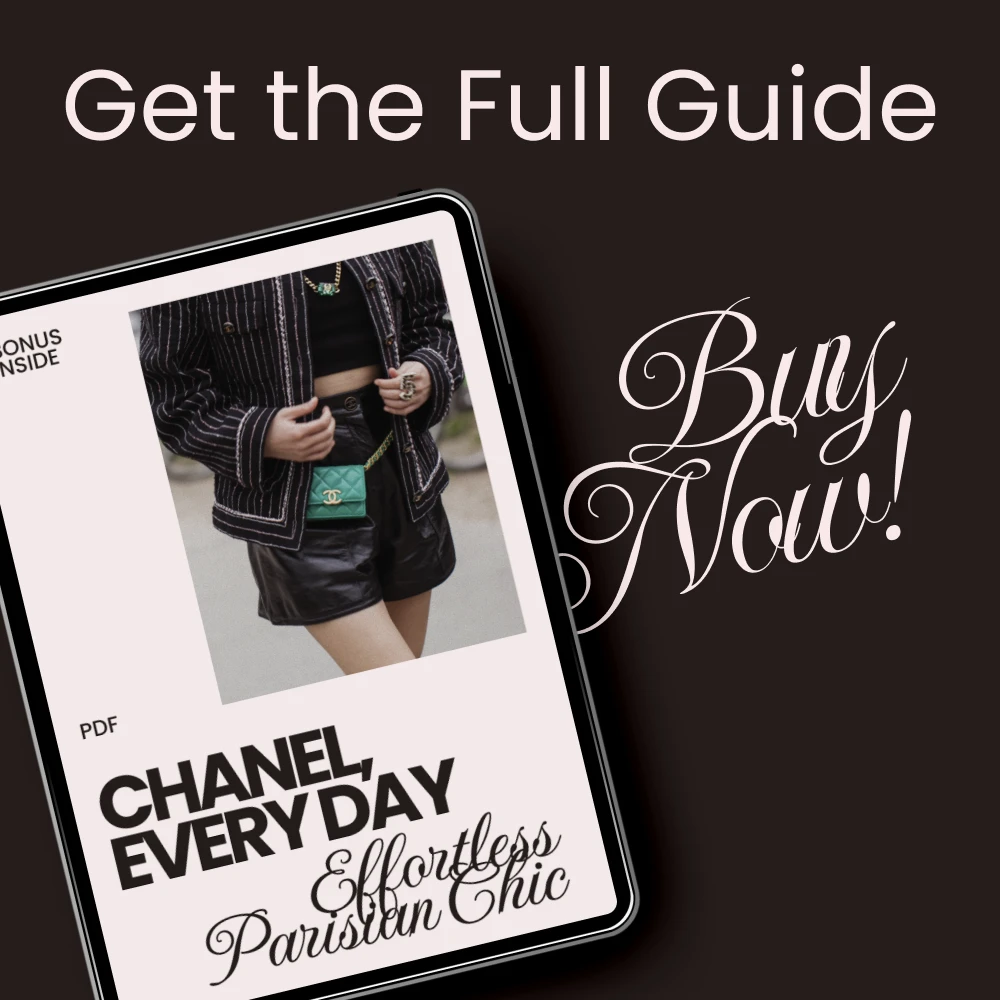
Effortless Parisian Chic, Designed for Real Life
What if you could capture the timeless elegance of Chanel and make it work for your Monday meetings, casual brunches, and last-minute dinner plans? Chanel, Every Day: Effortless Parisian Chic is your practical, beautifully structured guide to mastering chanel for everyday wear without looking overdressed, outdated, or trying too hard. This digital download shows you how to translate iconic French sophistication into modern, wearable outfits you’ll actually love putting on.
What’s Inside the Guide
- Chapter 1: The Chanel Mindset — Everyday Elegance Simplified Understand what “Everyday Chanel” really means, discover core wardrobe staples inspired by Chanel, learn the art of high–low styling, and explore a real-life case study from office to weekend in Chanel style.
- Chapter 2: Building a Wearable Chanel-Inspired Wardrobe Style the modern tweed jacket, choose the power of the classic bag, find shoes that elevate daily outfits, and avoid common mistakes that can cheapen a polished look.
- Chapter 3: Styling Chanel for Real Life Occasions Practical outfit formulas for workwear, casual weekends, and evening minimalism.
- Chapter 4: Smart Shopping & AI Styling Learn when to invest vs. imitate, use AI to curate outfits, create a digital capsule wardrobe, and map out your next steps with confidence.
Who This Is For
This guide is perfect for professionals, minimalists, fashion lovers, and modern women who admire Chanel but want realistic, wearable solutions. If you’ve ever searched for chanel for everyday wear and felt overwhelmed by luxury price tags or impractical styling advice, this was created for you.
Why This Guide Is Different
- Focuses on real-life styling, not runway looks.
- Teaches mindset and wardrobe strategy, not just outfit ideas.
- Blends luxury inspiration with accessible high–low combinations.
- Includes modern AI styling strategies to future-proof your wardrobe.
- Clear, structured chapters that take you from concept to execution.
Practical Benefits You’ll Experience
- Build a timeless wardrobe you can mix and match effortlessly.
- Save money by investing strategically instead of impulse shopping.
- Feel polished and confident in everyday settings.
- Create outfits faster with a defined personal style framework.
- Develop a signature look that feels elegant yet authentic.
Download Your Guide Today
Style should feel effortless, not intimidating. If you’re ready to refine your wardrobe, simplify your choices, and embrace true Parisian elegance in daily life, download Chanel, Every Day: Effortless Parisian Chic now and start building your own wearable interpretation of chanel for everyday wear.
SHIPPING
We are proud to offer international shipping services that currently operate in over 200 countries and islands world wide. Nothing means more to us than bringing our customers great value and service. We will continue to grow to meet the needs of all our customers, delivering a service beyond all expectation anywhere in the world.
Do you ship worldwide?
Yes. We provide free shipping to over 200 countries around the world. However, there are some locations we are unable to ship to. If you happen to be located in one of those countries we will contact you.
What about customs?
We are not responsible for any custom fees once the items have been shipped. By purchasing our products, you consent that one or more packages may be shipped to you and may get custom fees when they arrive to your country.
How long does shipping take?
Shipping time varies by location. These are our estimates:| Location | *Estimated Shipping Time |
|---|---|
| United States | 5-20 Business days |
| Canada, Europe | 5-20 Business days |
| Australia, New Zealand | 5-20 Business days |
| Central & South America | 5-25 Business days |
| Asia | 5-20 Business days |
| Africa | 5-25 Business days |
Do you provide tracking information?
Yes, you will receive an email once your order ships that contains your tracking information. If you haven’t received tracking info within 5 days, please contact us.
My tracking says “no information available at the moment”.
For some shipping companies, it takes 2-5 business days for the tracking information to update on the system. If your order was placed more than 5 business days ago and there is still no information on your tracking number, please contact us.
Will my items be sent in one package?
For logistical reasons, items in the same purchase will sometimes be sent in separate packages, even if you've specified combined shipping.
If you have any other questions, please contact us and we will do our best to help you out.
RETURNS
Order cancellation
All orders can be cancelled until they are shipped. If your order has been paid and you need to make a change or cancel an order, you must contact us within 12 hours. Once the packaging and shipping process has started, it can no longer be cancelled.
Refunds
Your satisfaction is our #1 priority. Therefore, you can request a refund or reshipment for ordered products if:
- If you did not receive the product within the guaranteed time (45 days not including 1-3 day processing) you can request a refund or a reshipment.
- If you received the wrong item you can request a refund or a reshipment.
- If you do not want the product you’ve received you may request a refund but you must return the item at your expense and the item must be unused.
We do not issue the refund if:
- Your order did not arrive due to factors within your control (i.e. providing the wrong shipping address)
- Your order did not arrive due to exceptional circumstances outside the control of ultimateselectionarena.shop (i.e. not cleared by customs, delayed by a natural disaster).
- Other exceptional circumstances outside the control of ultimateselectionarena.shop.
*You can submit refund requests within 15 days after the guaranteed period for delivery (45 days) has expired. You can do it by sending a message on Contact Us page
If you are approved for a refund, then your refund will be processed, and a credit will automatically be applied to your credit card or original method of payment, within 14 days.
Exchanges
If for any reason you would like to exchange your product, perhaps for a different size in clothing, you must contact us first and we will guide you through the steps.
Please do not send your purchase back to us unless we authorise you to do so.
Order cancellation
All orders can be cancelled until they are shipped. If your order has been paid and you need to make a change or cancel an order, you must contact us within 12 hours. Once the packaging and shipping process has started, it can no longer be cancelled.
Refunds
Your satisfaction is our #1 priority. Therefore, you can request a refund or reshipment for ordered products if:
- If you did not receive the product within the guaranteed time( 45 days not including 2-5 day processing) you can request a refund or a reshipment.
- If you received the wrong item you can request a refund or a reshipment.
- If you do not want the product you’ve received you may request a refund but you must return the item at your expense and the item must be unused.
We do not issue the refund if:
- Your order did not arrive due to factors within your control (i.e. providing the wrong shipping address)
- Your order did not arrive due to exceptional circumstances outside the control of ultimateselectionarena.shop (i.e. not cleared by customs, delayed by a natural disaster).
- Other exceptional circumstances outside the control of https://ultimateselectionarena.shop
*You can submit refund requests within 15 days after the guaranteed period for delivery (45 days) has expired. You can do it by sending a message on Contact Us page
If you are approved for a refund, then your refund will be processed, and a credit will automatically be applied to your credit card or original method of payment, within 14 days.
Exchanges
If for any reason you would like to exchange your product, perhaps for a different size in clothing. You must contact us first and we will guide you through the steps.
Please do not send your purchase back to us unless we authorise you to do so.
Customer Reviews
Write a Review
We Think You’ll Love
Top picks just for you












The 'replace, don't reinvent' approach to weekend dressing clicked immediately ✨
🇫🇷👜✨🤍
The Emma case study — same cream blouse and tweed jacket going from office to after-work dinner just by swapping loafers for slingbacks — is the kind of practical guidance I rarely find in style content. Most fashion advice treats each occasion as a separate wardrobe problem, but framing pieces as modular is how people actually dress. I redid my whole approach to mornings after reading this.
Avoiding ornate buttons on a tweed jacket for daily wear — never thought about that before.
For years I dressed well but never felt polished in a way that lasted more than an hour. My wardrobe was full of pieces that worked individually but rarely together, and I had a particular habit of saving anything I actually liked for occasions that never quite arrived. That mistake — keeping nice pieces for rare occasions — is named directly in this guide, and reading it felt like being called out by someone who'd watched my closet for years. The concept of wearing structured pieces constantly, not saving them, was the first real shift. I started treating my tweed-style jacket like a layering basic rather than a special item, throwing it over a white tee with straight-leg jeans exactly as the high-low examples suggest. Two weeks in, my daily routine felt less like getting dressed and more like editing — small decisions with clear logic behind them. The workwear section was useful too: the idea that in Chanel-inspired style the woman walks into the room and not the outfit reframed how I approach Monday mornings. I stopped trying to make my clothes interesting and started letting them be clean and intentional. The cost-per-wear framing in the smart shopping section was the final piece — I now own fewer things but use every single one of them, which is exactly the right outcome.
Confidence over excess — three words that rewired how I shop.
The breakdown of how to style a tweed jacket for daily life — slightly cropped, sleeves rolled, minimal shoulder padding — is exactly the kind of specificity that most style guides skip. The workwear quiet authority formula (structured jacket, silk blouse, straight-leg trousers, structured handbag) is genuinely usable as a daily checklist. My one note is that the guide moves quickly through evening styling; for how much depth it gives workwear and weekends, evenings felt underserved. Worth it overall, just not equally weighted across occasions.
Prioritizing shape over logo when buying a bag is advice I needed several years ago.
The casual transformation example — replacing a hoodie with a structured cardigan, swapping distressed jeans for dark straight-leg, adding a small quilted crossbody — is the clearest before-and-after in this kind of guide 🖤 It doesn't ask you to throw anything out or spend dramatically; it asks you to replace one element at a time. That approach makes the whole philosophy accessible rather than aspirational in an unreachable way.
I used to assume that looking polished required either spending a lot or making a significant effort, but this guide dismantled both assumptions fairly quickly. The point about Coco Chanel's original idea — that luxury should be comfortable — connected everything that followed. When I started applying the workwear formula (structured jacket, soft blouse, straight-leg trousers, minimal jewelry, structured handbag), the results were better than anything I'd achieved through more elaborate efforts. The note about keeping makeup fresh and hair polished but effortless was small but calibrating — it matched the overall approach of deliberate understatement rather than performance. What stuck most was the framing around confidence over excess: the aesthetic is about the person, not the clothes doing the work. I've read a lot of style content that claims to say this but few that structure the actual advice consistently around it.
One statement element — earrings or bold lipstick, never both competing. That rule saved my evenings.
The high-low styling examples are clear and immediately usable — quilted bag with an oversized blazer and sneakers is something I'd never tried but works beautifully. The guide's insistence that neutral color gives maximum combinations for a classic bag is useful, actionable advice. I would have appreciated more on how to choose between investing in an actual piece versus a quality imitation beyond the basic checklist; that section needed another page. Still, the underlying framework is sound and I return to it often.
The digital capsule wardrobe idea — tracking cost-per-wear across an actual clothing catalog — is genuinely smart.
💫🖤👜🌿🤍
The core wardrobe staples section is genuinely clear — tweed jacket, quilted bag, little black dress, ballet flats — and the modular logic behind the Emma office-to-weekend example shows real understanding of how people actually dress. Where the guide loses me slightly is in the smart shopping section, which references fabric quality, tailoring, timeless colors, and clean hardware without much guidance on how to evaluate those things in a store or online. It points in the right direction without fully taking you there. Good bones, but a few sections needed to go deeper.
Clean lines, structured silhouettes — now I see them everywhere and wish I'd chosen better.
Chanel style is about refining yourself, not impressing others — finally a genuine compass.
I work in a creative industry where the pressure to look interesting rather than elegant was something I hadn't really questioned until I read this. The point that Chanel-inspired style isn't about dressing up but dressing well, consistently, reframed what I was actually aiming for. The occasional-versus-daily distinction — stop saving nice pieces for rare occasions, luxury becomes practical when worn often — was the most personally useful thing in the guide. The evening minimalism section was strong too: choosing between a statement earring or bold lipstick rather than letting both compete is exactly the kind of small rule that makes getting dressed easier. My mild critique is that the AI styling sections repeat similar advice across multiple parts of the guide rather than building progressively — consolidating those tips would make the smart shopping chapter much stronger. Structurally sound; editorially could be tighter.
Slightly cropped tweed, no ornate buttons — two adjustments that modernize the whole silhouette.
What I didn't expect from this guide was how thoroughly it addressed casual dressing — the myth that Chanel style is formal is corrected early and the advice holds up. The weekend formula (straight-leg jeans, crisp top, light jacket, ballet flats or sleek sneakers) is something I now dress to on Saturdays without thinking about it 🤍 The contrast-toe footwear note and the point about harmony over attention-seeking in shoes closed a gap in how I was thinking about the bottom half of outfits.
The woman walks in, not the outfit — the best articulation of workwear dressing I've read.
Saved nice pieces for rare occasions for years — this guide cured that specific habit fast.
The invest-vs.-imitate framing — prioritizing fabric quality, tailoring, timeless colors, and clean hardware even on non-Chanel pieces — is the right way to think about building a wardrobe on any budget. The guide never makes the aesthetic feel out of reach, which is refreshing compared to fashion content that treats cost as a prerequisite for style. The 15-piece capsule wardrobe AI prompt idea is something I actually used, and the results were more useful than I expected.
I have a complicated relationship with fashion — I love the idea of it but historically struggle with the execution. My wardrobe was a collection of individual purchases that never communicated the same thing, and I'd been mixing expensive pieces with trend-driven fast fashion in a way the guide specifically calls out as a mistake. The coherence principle — quality across multiple pieces rather than one statement item — wasn't new to me as an idea, but seeing it framed around the Chanel philosophy gave it a structure I could actually use. I applied the evening minimalism advice first: the little black dress with slingbacks, one statement element, compact structured bag, nothing competing. Then I moved to weekdays with the workwear formula. What surprised me most was how much energy I stopped spending on getting dressed — decisions became cleaner, not harder. The closing reminder that Chanel style is about refining yourself rather than impressing others is something I've returned to several times.
Strong on the tweed jacket specifics, but the AI sections needed more original examples.
The attention to proportion and fabric quality throughout distinguishes this from style content that only addresses aesthetic surface. The note that oversized without structure looks sloppy — as opposed to intentionally relaxed — is a distinction a lot of dressing advice glosses over. Combining it with the point that you can still play with proportions and layering without confusing classic with conservative gave me a more useful range to work within than most fashion guides have.
Replace, don't reinvent — same comfort, elevated structure 🖤
I want to write this review with some precision because the guide earned it. I am a woman in my early forties who spent most of her thirties buying things based on what a particular season told her to want. My closet had texture and color variety but no internal logic, and almost every morning involved some version of standing in front of it and feeling uninspired despite having spent money I'd rather not account for. I came to this skeptically — I've read plenty of style content that promises clarity and delivers vague advice about investing in quality. What this one does differently is give you specific decision criteria at each level: cropped over boxy for the tweed jacket, medium size and neutral color for the bag, shape over logo when budget is the variable, beige and black flats or low block heels over trend-driven footwear. These aren't abstract principles; they're actual filters. The case study of Emma moving the same cream blouse and tailored trousers through three settings by changing shoes and bag made something click that years of fashion reading hadn't. The wardrobe audit steps at the end — identify three structured pieces you already own, remove one overtly trendy item, test one AI prompt — are genuinely low-friction starting points. I followed them in order and was surprised how much already existed in my closet that I'd been underusing. The before-and-after casual transformation is pinned on my phone. Same comfort. Elevated structure. That formula alone was worth finding this.
Real specifics, strong framing — the AI sections repeat themselves rather than building.
The evening minimalism guidance — little black dress, slingbacks, compact structured bag, and one statement element only — is more useful than generic advice to keep it simple. The point that earrings and bold lipstick shouldn't compete is specific enough to actually apply when getting ready. What made the whole guide cohesive was how consistently the same underlying principle — restraint as a choice, not a limitation — ran through every section from workwear to evenings.
Neutral tones with intentional contrast, not neutral tones with neutral everything — that distinction matters.
There's a particular failure mode I'd been stuck in for a long time: buying elevated pieces and then pairing them with everything else I already owned without considering whether it held together. The guide identifies this directly — combining a high-end bag with mass-market clothing creates imbalance, and coherence matters more than any single piece. I recognized myself immediately. Working through the wardrobe section deliberately, starting with the three structured pieces I already owned and building outward from there, was more productive than any shopping trip I'd taken in the previous two years. The advice about the tweed jacket specifically — slightly cropped, minimal shoulder padding, sleeves rolled for relaxed polish — changed how I looked at jackets I already owned versus what I was considering buying. The framing that Chanel-inspired style is modular was the most transferable idea in the guide, and I've used it to think about every occasion since.
Clear wardrobe logic throughout, though the shopping guidance needed more depth to match the styling sections.
The point about confusing classic with conservative — that you can still play with proportions and layering — opened up this guide in a way I hadn't expected. Most Chanel-adjacent content leans into formality, but the casual weekends section here is genuinely relaxed without being sloppy. The distinction between clean white sneakers for balance versus attention-seeking footwear is the kind of granular guidance that makes this useful rather than aspirational.
Ten outfits from eight pieces — the cost-per-wear logic finally clicked reading this guide.
👡🖤💎✨
The connection between the digital capsule wardrobe and reducing impulse buying is something I'd understood in theory but never applied in practice. Tracking how often you actually wear items versus how recently you bought them changes the math on purchasing decisions entirely. The guide frames this as the smart side of the Chanel philosophy — buying smarter, not more — and it's the most lasting shift the guide made in how I approach my closet.
I've tried various style frameworks over the years but always found them either too rigid or too vague to apply consistently. This guide struck a different balance. The workwear formula — structured jacket, silk or soft cotton blouse, straight-leg trousers or midi skirt, minimal jewelry, structured handbag — is specific without being prescriptive 🖤 The freedom to play with proportions and layering within that structure, without confusing classic with conservative, gave me more room than I expected. What I most appreciated was the shoe guidance: harmony not attention-seeking, contrast toes or refined simplicity, clean white sneakers for balance. Small decisions with clear principles behind them. The before-and-after casual transformation sealed the philosophy in a way the conceptual framing alone wouldn't have.
The quilted bag plus oversized blazer plus sneakers combination is something I use at least twice a week since finding this guide. The consistent emphasis on neutral tones for maximum wearability and clean hardware over decorative detail is thoughtful and applied throughout, not just stated once and forgotten. My one note is that the workwear and casual sections are much stronger than the evening section, which could have used the same level of granular detail. Strong guide with slightly uneven depth across occasions.
Structured but soft — two words that perfectly describe a daily wardrobe goal.
The AI styling prompts throughout the guide are a genuinely modern addition that doesn't feel forced — particularly the one suggesting you upload your existing clothes and generate ten distinct outfits from eight pieces ✨ That approach to maximizing cost-per-wear is a very Chanel way to think about a wardrobe, as the guide puts it directly. Framing AI as a personal stylist without the luxury price tag is honest about what these tools actually do well, and the examples are specific enough to use immediately.