


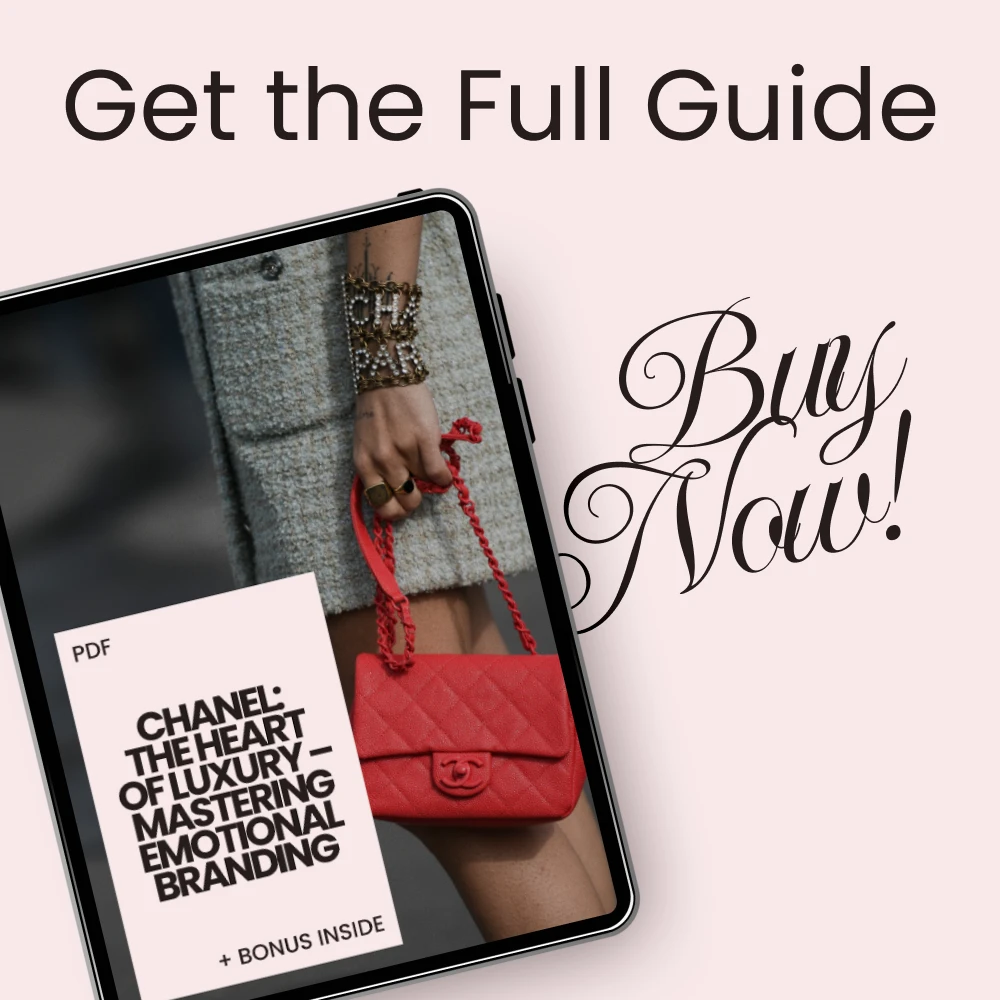
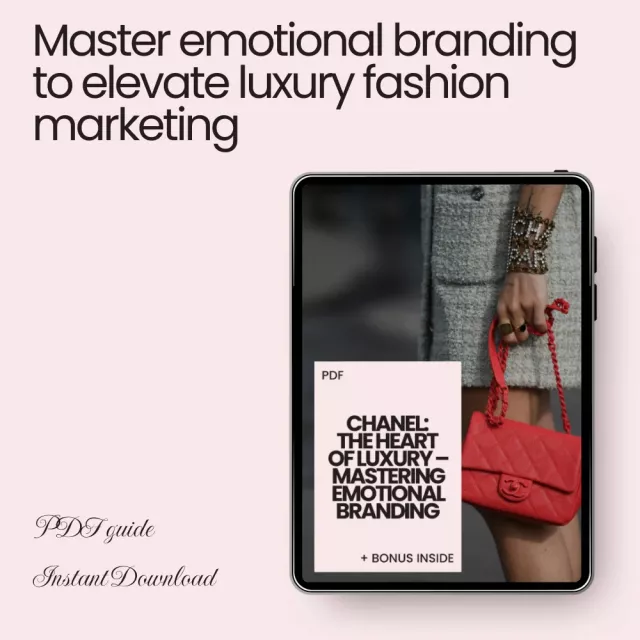
Transform Your Brand with the Power of Chanel’s Emotional Branding
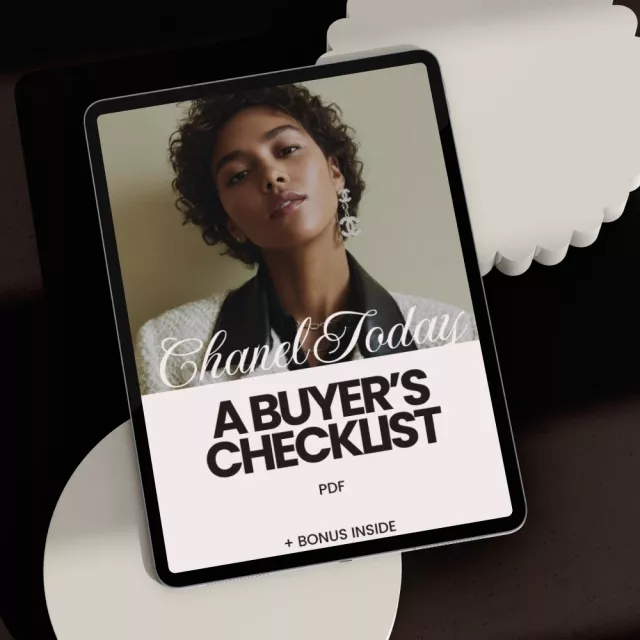
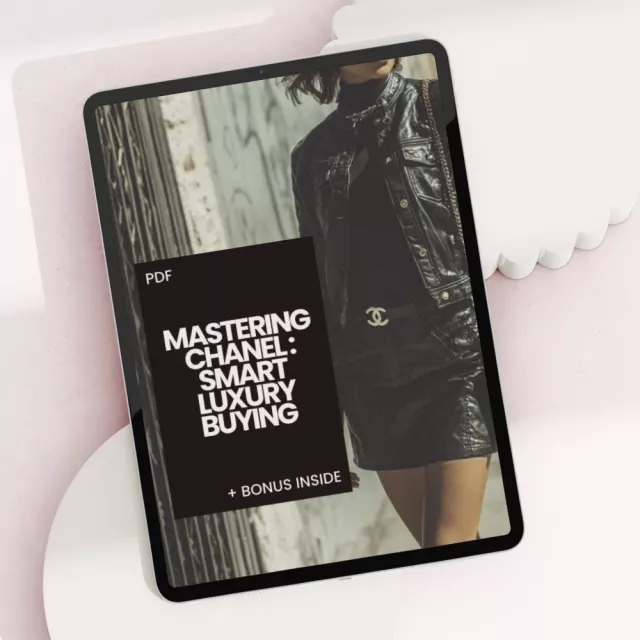
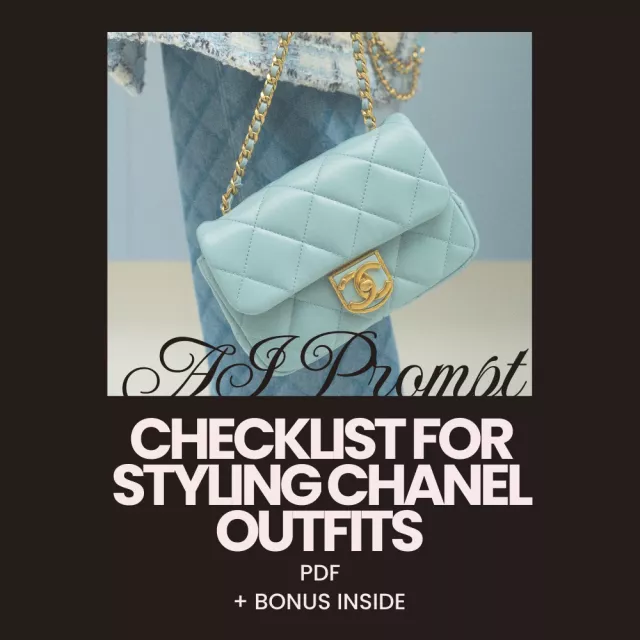
Unveil the secret to Chanel’s unparalleled success in the world of luxury fashion with “Chanel: The Heart of Luxury – Mastering Emotional Branding.” This exclusive digital download offers an insightful guide on how the legendary brand has masterfully crafted a story that stirs emotion, builds desire, and creates lifelong loyalty. Whether you’re in fashion, marketing, or business strategy, this eBook reveals the fundamental principles of emotional branding that have shaped Chanel into the symbol of elegance and sophistication we know today.
Discover how Chanel’s powerful emotional storytelling goes beyond just products—it’s about creating an emotional bond with consumers that resonates on a deeper level. By delving into Chanel’s approach, you’ll learn how to replicate their success in your own brand. Mastering emotional branding in the luxury market is more than a trend; it’s a strategic tool that transforms the way your customers connect with your brand.
Key Features of “Chanel: The Heart of Luxury – Mastering Emotional Branding” eBook:
- Deep Dive into Chanel’s Emotional DNA: Explore Coco Chanel’s vision, legacy, and how the brand evokes feelings of timeless elegance, freedom, and sophistication.
- Signature Campaigns and Brand Experiences: Learn about Chanel’s iconic marketing strategies that stir emotions and create unforgettable brand experiences.
- Storytelling Techniques for Luxury Branding: Discover the power of storytelling in luxury fashion and how Chanel uses emotional archetypes to connect with its audience.
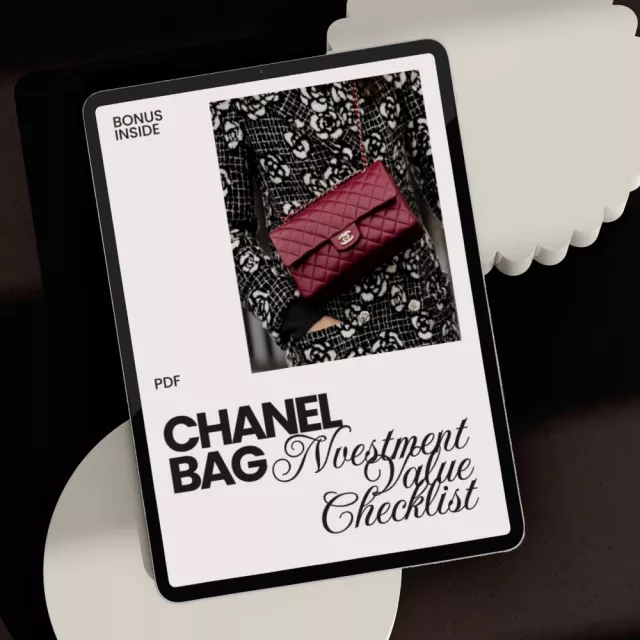
- Practical Exercises and Checklists: Apply the strategies with exercises designed to help you develop your own emotional branding approach.
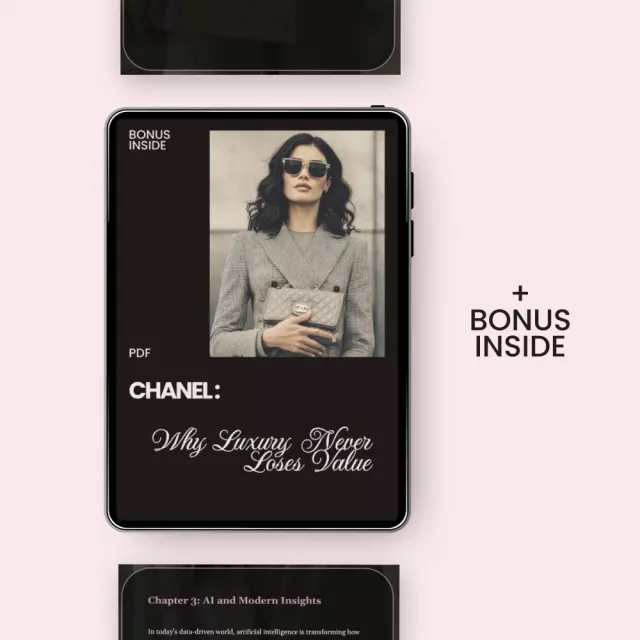
- AI Integration in Branding: Learn how to leverage AI tools to amplify your emotional branding efforts and drive customer engagement.
- Comprehensive Case Studies: Analyze Chanel’s famous campaigns, including Chanel No. 5, to understand the emotional impact on consumers.
Why You Need This Guide:
“Chanel: The Heart of Luxury – Mastering Emotional Branding” is the ultimate resource for anyone looking to elevate their brand’s emotional connection with customers. Perfect for marketers, brand strategists, fashion enthusiasts, and business owners, this eBook is packed with actionable insights and real-world examples. It’s not just about learning from Chanel—it’s about applying these principles to your own brand. Whether you’re creating campaigns, designing customer experiences, or building your brand story, this guide will help you master the art of emotional branding to stand out in a competitive market.
Ready to Master Emotional Branding?
Download “Chanel: The Heart of Luxury – Mastering Emotional Branding” today and start creating an unforgettable brand that resonates with emotions. Whether you’re a small business or an established luxury brand, this guide will help you craft experiences that go beyond products—experiences that your customers will love and remember.
SHIPPING
We are proud to offer international shipping services that currently operate in over 200 countries and islands world wide. Nothing means more to us than bringing our customers great value and service. We will continue to grow to meet the needs of all our customers, delivering a service beyond all expectation anywhere in the world.
Do you ship worldwide?
Yes. We provide free shipping to over 200 countries around the world. However, there are some locations we are unable to ship to. If you happen to be located in one of those countries we will contact you.
What about customs?
We are not responsible for any custom fees once the items have been shipped. By purchasing our products, you consent that one or more packages may be shipped to you and may get custom fees when they arrive to your country.
How long does shipping take?
Shipping time varies by location. These are our estimates:| Location | *Estimated Shipping Time |
|---|---|
| United States | 5-20 Business days |
| Canada, Europe | 5-20 Business days |
| Australia, New Zealand | 5-20 Business days |
| Central & South America | 5-25 Business days |
| Asia | 5-20 Business days |
| Africa | 5-25 Business days |
Do you provide tracking information?
Yes, you will receive an email once your order ships that contains your tracking information. If you haven’t received tracking info within 5 days, please contact us.
My tracking says “no information available at the moment”.
For some shipping companies, it takes 2-5 business days for the tracking information to update on the system. If your order was placed more than 5 business days ago and there is still no information on your tracking number, please contact us.
Will my items be sent in one package?
For logistical reasons, items in the same purchase will sometimes be sent in separate packages, even if you've specified combined shipping.
If you have any other questions, please contact us and we will do our best to help you out.
RETURNS
Order cancellation
All orders can be cancelled until they are shipped. If your order has been paid and you need to make a change or cancel an order, you must contact us within 12 hours. Once the packaging and shipping process has started, it can no longer be cancelled.
Refunds
Your satisfaction is our #1 priority. Therefore, you can request a refund or reshipment for ordered products if:
- If you did not receive the product within the guaranteed time (45 days not including 1-3 day processing) you can request a refund or a reshipment.
- If you received the wrong item you can request a refund or a reshipment.
- If you do not want the product you’ve received you may request a refund but you must return the item at your expense and the item must be unused.
We do not issue the refund if:
- Your order did not arrive due to factors within your control (i.e. providing the wrong shipping address)
- Your order did not arrive due to exceptional circumstances outside the control of ultimateselectionarena.shop (i.e. not cleared by customs, delayed by a natural disaster).
- Other exceptional circumstances outside the control of ultimateselectionarena.shop.
*You can submit refund requests within 15 days after the guaranteed period for delivery (45 days) has expired. You can do it by sending a message on Contact Us page
If you are approved for a refund, then your refund will be processed, and a credit will automatically be applied to your credit card or original method of payment, within 14 days.
Exchanges
If for any reason you would like to exchange your product, perhaps for a different size in clothing, you must contact us first and we will guide you through the steps.
Please do not send your purchase back to us unless we authorise you to do so.
Order cancellation
All orders can be cancelled until they are shipped. If your order has been paid and you need to make a change or cancel an order, you must contact us within 12 hours. Once the packaging and shipping process has started, it can no longer be cancelled.
Refunds
Your satisfaction is our #1 priority. Therefore, you can request a refund or reshipment for ordered products if:
- If you did not receive the product within the guaranteed time( 45 days not including 2-5 day processing) you can request a refund or a reshipment.
- If you received the wrong item you can request a refund or a reshipment.
- If you do not want the product you’ve received you may request a refund but you must return the item at your expense and the item must be unused.
We do not issue the refund if:
- Your order did not arrive due to factors within your control (i.e. providing the wrong shipping address)
- Your order did not arrive due to exceptional circumstances outside the control of ultimateselectionarena.shop (i.e. not cleared by customs, delayed by a natural disaster).
- Other exceptional circumstances outside the control of https://ultimateselectionarena.shop
*You can submit refund requests within 15 days after the guaranteed period for delivery (45 days) has expired. You can do it by sending a message on Contact Us page
If you are approved for a refund, then your refund will be processed, and a credit will automatically be applied to your credit card or original method of payment, within 14 days.
Exchanges
If for any reason you would like to exchange your product, perhaps for a different size in clothing. You must contact us first and we will guide you through the steps.
Please do not send your purchase back to us unless we authorise you to do so.
Customer Reviews
Write a Review
We Think You’ll Love
Top picks just for you













The emotional archetypes table in Chapter 3 — Rebel, Creator, Lover — gave me a vocabulary I'd been missing for years. Mapped my own brand to the Creator archetype within ten minutes of reading it.
The Chanel No. 5 case study alone justifies downloading this.
I run a boutique fragrance line and I've spent two years trying to articulate why our marketing felt flat despite beautiful product photography. Chapter 4's point about focusing on features instead of feelings was the diagnosis. We were highlighting ingredients and craftsmanship in every post without connecting any of it to desire or legacy. After reading the guide I rewrote our entire campaign brief around three target emotions — intimacy, nostalgia, and quiet confidence — and the engagement difference on our next launch was immediate. Our social team said it was the first campaign where comments described how the product made people feel rather than just how it looked.
The sensory branding section on scent, touch, and ambience in Chapter 2 was a masterclass in details most marketers overlook.
Chapter 1 framing Chanel as an emotional experience rather than a brand reframed my entire approach.
The introduction set the tone perfectly — products alone aren't enough, and the rest of the guide delivers on that promise.
The consistency-across-touchpoints section in Chapter 4 exposed exactly where my brand was leaking emotional impact. Different tone on social versus our website, different visual language in email versus packaging. I ran the emotional branding checklist the guide suggests — visuals, copy, sensory cues, tone — across every platform we use and found seven inconsistencies in one afternoon. Fixed five of them that week. Client feedback shifted noticeably within a month, with people describing our brand using the exact words we intended for the first time.
❤️🔥✨👏
The AI prompts in Chapter 5 for campaign ideation are copy-paste ready.
The practical exercise in Chapter 3 — pick one product, identify three emotions, create a mini story — took me twenty minutes and produced a better brief than my last agency did in a week.
Chapter 6 on measuring emotional impact beyond sales was the section I didn't know I needed. The distinction between engagement, brand recall, and sentiment analysis gave our analytics team a framework they'd been asking for.
The emotional DNA concept in Chapter 1 — timelessness, elegance, freedom as three pillars — is the kind of simple structural insight that makes everything else in the guide click.
I manage brand strategy for a mid-size accessories label and this guide changed how I brief creative teams. Before, I'd give them product specs and mood references. Now I lead with three target emotions and an archetype, exactly as Chapter 3 recommends. The quality of first drafts improved so dramatically that our revision cycles dropped from four rounds to two. The AI prompts in Chapter 5 also saved us during a tight deadline — I fed one into our workflow and got three viable campaign directions in an hour that would have taken a brainstorm session a full day.
The warning about mixing conflicting archetypes in a single campaign is so precise 🙌
Concise, structured, and every chapter earns its place.
The guide is strong throughout, but the neuromarketing section in Chapter 6 — eye tracking, facial expression analysis, skin conductance — felt more like a teaser than a deep dive. I wanted specific tools or case data. The rest of the measurement chapter compensates with actionable social listening and survey frameworks, though.
The feature-to-emotion mapping concept in Chapter 4 should be standard in every marketing department.
I teach luxury brand management at a graduate level and this is the tightest bridge between classical branding theory and modern AI application I've found in a downloadable resource. The archetype table in Chapter 3 is already in my slide deck. The Chanel No. 5 case study progression from the Monroe era through modern cinematic campaigns gave my students a concrete timeline for how emotional positioning evolves without losing core identity. Three of them used the Chapter 7 checklist for their final brand strategy projects and each produced sharper work than the previous cohort managed with textbooks alone.
💎🖤⭐👌
The point about luxury consumers buying emotions rather than functionality landed hard.
Chapter 2 on crafting desire through fashion shows as emotional touchpoints — themed runways like ice rinks and supermarkets — made me rethink how I stage my own brand events entirely.
The cultural context warning in Chapter 4 is the kind of risk management advice most branding guides skip. Appreciated the practical suggestion to test campaigns with AI sentiment analysis across target markets before launch.
I appreciated the storytelling and emotional measurement chapters, but the AI content across Chapters 5, 6, and 7 covers overlapping ground — predictive sentiment analysis appears in slightly different framing in each. Consolidating that into one focused AI chapter would tighten the whole guide. Still, the Chanel analysis and practical exercises are excellent.
I'm a creative director at an agency that handles two luxury accounts and I bought this on impulse during a commute. By the time I got to Chapter 3 I was taking screenshots to send to my team. The narrative techniques section — visual storytelling through black-and-white cinematography, emotional archetypes, consistency across touchpoints — mapped precisely onto a problem we'd been debugging on a fragrance account for months. We'd been oscillating between rebellious and romantic tones across platforms and couldn't figure out why the brand felt diluted. Chapter 4 named the exact mistake. I restructured our next campaign around a single primary emotion as the guide recommends, and the client said it was the most cohesive creative we'd ever presented to them.
The one-paragraph brand story exercise in Chapter 7 crystallized six months of strategic drift into four sentences.
Emotion trumps features — that line from the Chapter 2 takeaway section rewired my entire product copy approach.
Chapter 7's practical checklist for launching an emotional brand is the most actionable closing I've seen in a strategy guide.
The predictive sentiment testing concept — evaluating campaigns across cultures before launch — is where this guide goes from theoretical to operational.
I work in experiential retail design and the in-store sensory section in Chapter 2 articulated principles I've felt intuitively for years but never codified. Scent triggering memory and desire, tactile materials deepening attachment, ambience reinforcing narrative — each of those points maps directly to decisions I make on every project. I've since built a sensory audit checklist modeled on this chapter that I run through with clients before any store build. Two clients have already told me the audit alone was worth my consulting fee, which is a compliment I'm redirecting straight to this guide.
🔥👏💎✨🖤
The Rebel archetype breakdown — how Chanel broke fashion rules with the LBD and menswear-inspired suits to make customers feel empowered — is the clearest archetype application I've read outside of a Jungian textbook.
Read this expecting a surface-level Chanel fan piece and got a legitimate emotional branding strategy framework instead.
The guide covers a lot of ground well, though the competitor case study in Chapter 4 stays deliberately vague about which brand faced the cultural backlash. Naming it — or at least giving more specifics — would have made the lesson stick harder. The Chanel-specific analysis throughout is sharp and well-sourced.
Printed the Chapter 7 checklist and taped it to my office wall.
The framing of AI as a tool that enhances rather than replaces authentic storytelling in Chapter 5 is the most balanced take on AI in luxury marketing I've encountered. Practical without being breathless.
Every touchpoint telling the same emotional story — that's the thread running through all seven chapters and it holds.